महिला अधिकार र सामाजिक न्यायकी अथक् योद्धाः अधिवक्ता श्रीना नेपाल
८ कक्षा पढ्दै गर्दा कविताको किताब निकालेर समाजलाई केही दिने अठोट गरेकी श्रीना नेपाल आज सर्वोच्च अदालतमा सार्वजनिक हितका मुद्दा लड्ने सशक्त युवा अधिवक्ता बनेकी छिन्। स्यानिटरी प्याडको 'पिंक ट्याक्स' हटाउनेदेखि महिलाको नागरिकता अधिकारसम्मका मुद्दामा उनको संघर्ष र सफलताको कथा।
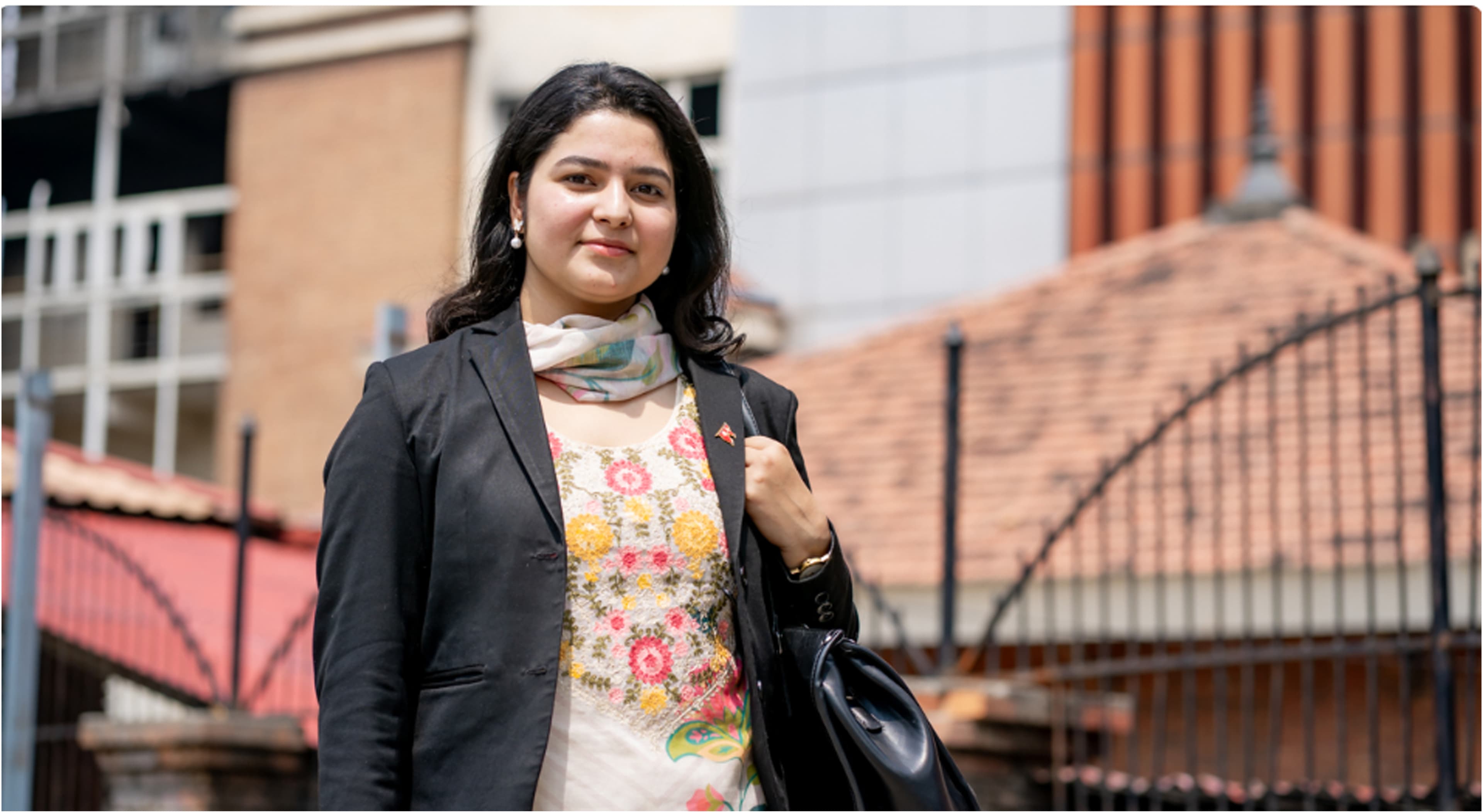
Indomitable Advocate for Women's Rights: The Inspiring Journey of Shreena Nepal KATHMANDU. In the 8th grade, a young girl published a book of poetry. On the back cover, she wrote: "I must give something back to society." That small path carved by a child has now transformed into a wide highway of social change. That girl is Shreena Nepal.
At 25, Shreena is not just a brilliant student at the Kathmandu School of Law; she has established herself as a sharp young legal scholar, an insightful writer, and a relentless activist who argues Public Interest Litigation (PIL) in the Supreme Court.
From the historic verdict to remove the discriminatory "Pink Tax" on sanitary pads to stopping the misuse of pollution taxes on petrol, regulating surrogacy and IVF, returning the Toran of Kumari Chhen, and ensuring women's citizenship rights—she is constantly knocking on the doors of the temple of justice with grave social issues in hand.
Childhood: Where the Seeds of Change Were Sown Born on September 4, 2000, amidst the natural beauty of Ilam, Shreena spent her childhood in the cultural city of Bhaktapur. She still lives in Bhaktapur with her father, Nawaraj Nepal, her mother, Jhuna Sharma, and her brother.
While her family was modest, they were intellectually open and deeply encouraging. From her father, who is active in the media sector, she learned about social responsibility and awareness; from her mother, she learned ethics and life values. Her grandfather was a scholar who wrote verses and poems in Sanskrit. Perhaps that ancestral influence and the literary atmosphere of her home taught her to love words from an early age.
As a child, she was quiet, often staying in her room to paint or do handicrafts. However, she was always a standout in extracurricular activities at school. She was never one to back down in oratory or poetry competitions. Teachers would read her creative writing not just in her class, but to students in other sections. "You can't say anything to Shreena; she'll just write about it," her friends used to tease—a comment that only fueled her energy.
By grade 8, she published her first article on gender justice. That same year, with the support of her school and family, she released her first collection of poems. "At that time, I just wrote whatever came from within," Shreena recalls. Looking back at that book today, she surprises herself—how could an 8th-grade girl write such profound social philosophy?
The Shift from Science to Law Shreena completed her early schooling at VS Niketan and Pathshala (Grades 1 to 10). After passing her SLC in 2015, she chose to study Science for her Plus Two at Ambassador Academy, keeping her family's wishes and future options in mind. However, her heart found more joy in social, political, and philosophical books than in scientific formulas.
After SLC, she participated in the "SLC Princess" beauty pageant. The grooming sessions among 50 contestants played a significant role in developing her confidence and personality. After Plus Two, she worked at "Radio Janata" for about a year, which further refined her eloquence. She even spent some time working in television serials, music videos, and short films, getting a close look at the world of media and glamour.
Deep down, however, these experiences weren't enough to satisfy her urge to serve society. She realized: "My path is not just science or media; the most powerful weapon to bring justice to the grassroots is Law." Her family fully supported her decision, and she enrolled at the Kathmandu School of Law (KSL).
Struggles and Successes Within Court Walls Once she began studying law, Shreena’s activism expanded beyond the classroom. In her first year, she joined the campaign against acid attacks, collaborating with Ujjwal Bikram Thapa. Although the COVID-19 lockdown briefly hindered progress, the campaign eventually succeeded with the introduction of a strict ordinance.
In her second year, she raised an issue that sparked a national debate: the "Pink Tax"—the unfair tax on sanitary pads. Along with friends, she conducted intensive research for six months, studying UN reports, company policies, and government data. She filed a writ in the Supreme Court demanding the removal of tax on imported pads, incentives for domestic production, and the removal of customs duties on raw materials. It took over a week just to register the case, but she did not give up.
After a four-year legal battle, the court finally issued a Mandamus to remove the tax and promote local industries. This was a massive victory for Shreena and all Nepali women.
In her third year, she filed another significant case against the misuse of the "Pollution Tax" (Rs. 1.50 per liter on petrol) intended to combat Kathmandu’s extreme air pollution. Arguing that the government was not utilizing the funds correctly, she secured an interim order from the Supreme Court to create a dedicated fund.
Beyond this, she leads campaigns during the 16 Days of Activism against gender-based violence and conducts legal awareness classes in public schools across the Kathmandu Valley.
The Power of the Pen: Bridging Law and Society Writing remains one of Shreena’s strongest suits. Her articles are inspired by events and the emotions they evoke. "If someone says a girl shouldn't do this, I write against it immediately," she says. She recalls waking up at 12:30 AM to write after watching the Bollywood film Pink.
To date, she has published over 50 articles in prestigious national dailies and online portals like MyRepublica, Nagarik, The Rising Nepal, and The Kathmandu Post. She writes primarily on gender justice, human rights, heritage, and the environment. Her core theme is: "What is happening in society, what does the law say, and what is the gap between the two?"
Two of her books are currently in the works. "Not At Last," a book on the impact of modernization, cultural shifts, and the heritage crisis, is coming soon. She is also writing a book on women’s citizenship rights based on her academic thesis. For this, she used the Right to Information (RTI) to collect data from District Administration Offices in all 77 districts. "I am exposing how the patriarchal mindset in the bureaucracy prevents women from obtaining citizenship," Shreena says firmly.
International Platforms and Eco-Feminism In 2024, she was selected for a scholarship to the Global Campus in Italy for training in "Cinema Advocacy and Human Rights." Upon her return, she implemented a project in collaboration with the Metropolitan City.
Associated with "Photo Circle," she has worked with indigenous communities in Dharan, Khokana, and Chitwan. Having worked as a researcher for the "Feminist Memory Project," she is now initiating a new discourse by linking "Eco-Feminism" and "Heritage Feminism." She notes that while heritage and women are often linked, they are rarely analyzed from a feminist perspective.
The Journey Continues: A Message to Youth While she admits to being more hesitant to post her poetry on social media these days as she matures—fearing how others might perceive it—her goals remain crystal clear. She wants to fight more public interest cases, publish her books, and bring marginalized issues like eco-feminism into the mainstream.
Every day, she visits the Supreme Court to check the status of her cases and hearings. "This is a matter of great personal satisfaction for me," she says with a smile.
Shreena’s journey, which began with a small poem in the 8th grade, has evolved into a national movement within the courtroom. She is a living example that when you have family support and a firm resolve, age is no barrier.
Related Articles

Comments
No comments yet. Be the first to share your thoughts.